Christians against Christians: The Anti-heretical Activities of the Roman Church in the Second Century
The church of Rome was actively involved in the disputes and conflicts that challenged the Christian movement throughout the Roman Empire from a very early period. Its interference in the affairs of other com- munities is most evident in the anti-heretical campaigns launched by its leaders as well as in the efforts those leaders made to found a universal church.
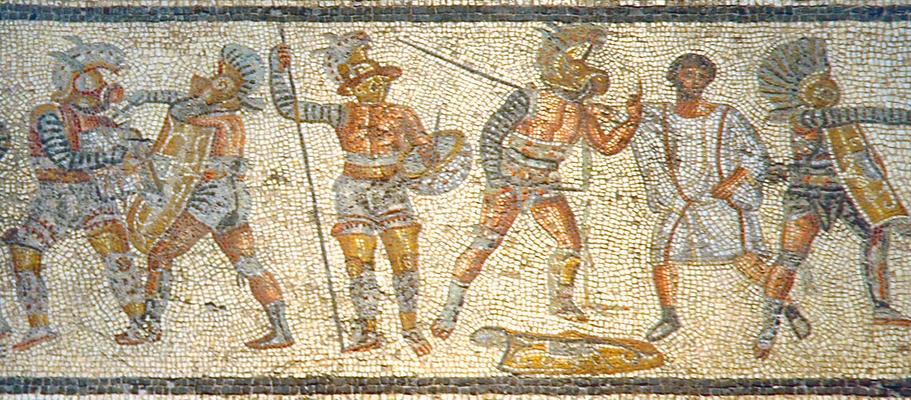
Gladiatorial games as a means of political communication during the Roman Republic
his article argues that the gladiatorial shows found their origin in the republic and were very popular. They therefore became frequent and were used for the most basic of political ends, namely votes for an election.
Wrongfully Accused: The Political Motivations Behind Socrates’ Execution
In 399 B.C.E., Socrates was executed by the Athenian court on charges of impiety and corrupting the youth. The controversial decision lingers atop the great legacy of Athens, a city praised for its intellectual and political liberty. However, the reasons behind Socrates’ execution are themselves questionable.
The characterisation of Mark Antony
This dissertation aims to focus on the way in which Marc Antony has been portrayed in Antiquity by a careful and critical study of what the ancient (mainly literary) sources have to reveal about this historical personage.
Born to be emperor: The principle of succession and the Roman monarchy
When Constantine I was acclaimed emperor by the Roman troops in Eburacum (York) after the death of his father Constantius Chlorus in the summer of 306, this step was at once both extraordinary and predictable—and it was probably seen as such by contemporaries, whether or not they considered the Imperium Romanum a hereditary monarchy
The Legion Re-Envisioned Analysis of the Roman Military: 4th Century AD
The fascination European thought has had with the Roman Empire is the result of several salient characteristics particular to that empire. Rome was the only political entity to successfully found an empire that united all the elements of the Mediterranean world.
The so-called Galatae, Celts, and Gauls in the Early Hellenistic Balkans and the Attack on Delphi in 280–279 BC
The thesis indicates that the establishment of Galatia as a geopolitical entity was probably unrelated to these incursive activities as traditionally indicated by the primary sources.
A Pagan and Christian interpretation of the 387 Riot of the Statues
This paper explores the conflicting accounts of John Chrysostom and Libanius regarding events related to the 387 Riot of the Statues in Antioch. I argue that the differing accounts were both authors’ attempts to shape the perception of the persons responible for attaining the pardon.
Forget Aristotle: Alexander the Great and the military origins of modern political organisation
My argument is that it was the political organisation of the Macedonian military, developed by Philip of Macedon, that formed the basis of Alexander the Great’s notion of empire.
Republics between hegemony and empire: How ancient city-states built empires and the USA doesn’t (anymore)
This paper discusses the concepts ‘empire’ and ‘hegemony’, provides a new model of the institutional structure of ancient ‘citizen-city-state empires’, and argues that the contemporary USA cannot be defined as an ‘empire’.